Showing posts with label Interview. Show all posts

Friday, August 5, 2011

EPIDERMIS: The Poetry of Skin

This interesting crossover of publishing, art and biology was recently brought to my attention:


EPIDERMIS: The Poetry of Skin is a collaborative effort from photographer Doug Prince and poet Scott A. Gallaway, and includes an interpretive essay by Andrew E. Hershberger.  I found the images to be beautiful, and the sample pages available for viewing here are quite compelling.


Artist's Statement:

"Epidermis is the outermost layer of the skin. It forms the waterproof, protective wrap over the body's surface and is made up of stratified squamous epithelium with an underlying basal lamina." - The Encyclopedia of Medical Terms

"These images are the latest state of a body of work started in 2005 titled, Dermis.  I am interested in transforming digital images of human skin into new, graphic compositions.  I select images as a working pallet based on color, texture and gradation, and their potential to lend themselves to my own aesthetic interest. Then I digitally reconstruct them into new forms, surfaces and lines.   The resulting images often parallel forms found in geological, anatomical, and biological subjects.  I am motivated by the joy of creating new organisms and the discovery of new landscapes.   I am also interested in maintaining some of the original photographic details, as artifacts, in the new composition.  This allows a play and tension between these photographic elements and the abstract frameworks in which they are embedded." ~ Douglas Prince

I got in touch with Prince to ask a few questions about his work on this project:

BA:  You have a large portfolio of artwork on your site. What inspired you to create a book of your photographs?
DP: The book format seemed like a natural culmination of a body of work and an extension of the digital process. It was something that I could organize and design and present to an audience.  Although the distribution is a challenge and the audience is small. Since I couldn't find a "regular" publisher, I decided to setup Maple Seed Press and do it myself.


BA:  How did you choose this body of work to present in a book form?
DP: I was working on EPIDERMIS, at a time when Andrew E. Hershberger and I were both teaching at the New Hampshire Institute of Art.  Andrew was teaching a history of photography course and I was teaching photography. We started spending time discussing photography and related topics, he became interested in the work I was doing and I was very pleased that he was interested in working on an interpretive essay for the book project. This was an inspiring and fruitful partnership, we worked together discussing the concepts in the essay and he participated in the editing of the images.


BA: Was the experience of gathering your artwork into book format and collaborating with Scott Gallaway a positive one? 
DP: Andrew introduced EPIDERMIS to Scott when he returned to GBSU, Bowling Green, OH.  Scott responded to the images and asked if he could do a set of ekphrastic poems for each page.  I was delighted with this addition to the book.  Both Andrew's and Scott's contributions have expanded the insights into the work.

BA: Do you have plans on publishing other books in the future?
DP: The next big project I will be working on is a 50-year retrospective (from silver to pixel), collaborating with Andrew.  Hopefully we will get the interest of a museum and publish a catalogue.

I would like to acknowledge an important influence:  Ralph Gibson's understanding of the beauty and power of the book has been both instructive and an inspiration.  He published his work, pre-digital, through Lustrum Press, 1970-1985.   http://www.ralphgibson.com/

~~~~~~~~~~~~~~~~~~~~~~~~~~~~~~~~~~~~~

Other book-form projects by Prince:  The exhibition catalog for All Possible Worlds and Evolving Vision: Explorations in Digital Image-Making.  You can see more of his artwork and larger, more detailed views of the sample pages for EPIDERMIS at his website, DouglasPrince.com.  The book itself is available for purchase here.

Tuesday, July 26, 2011

Tenebrous: An Interview with Santiago Caruso


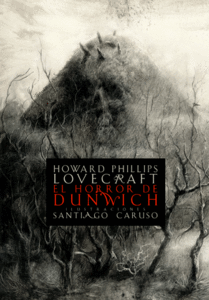
I first discovered Santiago Caruso's artwork while browsing the web for images associated with the writings of H.P. Lovecraft.   I found a gorgeous illustration of The Dunwich Horror, and immediately followed the link to discover its creator.
Santiago Caruso is a 29-year old artist in Buenos Aires, Argentina. My first impressions from visiting his website were:  blood, fear, passion, desolation, and an incredibly precise and disciplined execution.  One of the first images I clicked on at random was the illustration of Our Ladies of Sorrow (below), which I may have stared at for hours.


It turns out that Dunwich was Caruso's first freely chosen full-book illustration project - one that wasn't done for school, and was from his own inspiration.  He has since given his visual interpretation to several other works in the dark genres.  Caruso's body of literary work includes selections from Ambrose Bierce, Alejandra Pizarnik, and Daisaku Ikeda as well as Lovecraft.  He also has a rich portfolio of cover art for publications through Miskatonic Press and Nightshade books, all of which are beautiful and engaging.  He is also an active member of the Beinart International Surreal Art Collective.  

Santiago Caruso, Our Ladies of Sorrow
Recently Santiago generously took time to answer a few questions for Book Aesthete:

BA:  Your work combines my two favorite things:  literature and the macabre.  You’ve illustrated books of several of my favorite authors including Bierce and Lovecraft, as well as several covers for Miskatonic Press.  Were you a fan of the horror genre when you were young?  Which authors, artists, films etc. influenced your style?

"When I was a kid I didn´t see horror movies. My parents didn´t allowed me to see those kind of things.  Today, I still don´t see horror films, in the new gore concept, I mean. I really like the tenebrism, the mystery, suspense, supernatural, but always aesthetic. Recently, I have found the films of Ken Russell and I must say that The Devils is now one of my dearest movies. My introduction into the macabre and horror was done by the hand of Edgar Allan Poe at the age of 12. Before that,   read fantastic fiction and comics. But with Poe I reached other lands, painted with dark glazes, strong and poetic words, and a macabre sense of the fantastic. 


Later, with the opus of Baudelaire and the other decadent authors, I built my way of speaking in silence. Specifically, the work of Marcel Schwob is a definitive influence on my way of thinking of an image, a theme, the fantastic.  The German Expressionism cinema added to the Symbolism in painting is my school. Redon, Kupka, Moreau, Klinger, Ensor and Vrubel are also great influences on my visual concept."

BA- I’ve always been curious why some artists take the path of literary illustration as opposed to other art forms.  How does working with a living author enhance or hinder your artistic visions for the book?  How does it differ from illustrating a book who’s author is no longer living?
Santiago Caruso, The Monk and the Hangman's Daughter

"I came to illustration through the comic discipline, so the images I made always came from a story or situation I´ve imagined or read. I try to say something to you. With time I learned to let you be free to read my image as you want, with more aperture into the possible meanings and interpretations, closer to the classic art than the usual illustration way.

I didn´t work directly with a writer until those wonderful short tales by Ángel Olgoso that I illustrated (2011). Before that, the writers were already dead or silenced by the editors. The collaboration and feedback must be made with respect for each other's discipline and talent, kneaded by generosity and kindness. 

Easier is to work with the text of a deceased author. You have complete freedom to interpret the book - I mean almost complete, depending on editors and the kind of text you have. For example, my first illustrated book, chosen with liberty and no educational purpose, was The Dunwich Horror. Well, I wanted to illustrate something from Lovecraft and for the editors from Libros del Zorro Rojo too. We agreed to that piece. Good, but the structure of the story, the speaking voice was nearer to a chronicle, and this fact limited me at the beginning of the creative process. I followed the story in some parts. I painted some moments that could have happened but the text didn´t mentioned directly, and many other images more visionary, taking advantage of the nightmarish aspects. You must gain your liberty with hard working, hard thinking. I was inexperienced."

Gabinete de Maravillas,2011 (from the Caruso-Olgoso collaboration)
BA- On your website you mention the project in process with Ángel Olgoso [mentioned above]:  “Los Demonios Del Lugar”. Can you tell us a bit more about that?  What is it like collaborating with Olgoso? Can we look forward to the publication soon?
"I met Angel in person in April. He is a marvelous human being and a complex writer. We are trying to find a publisher in Spanish to publish an illustrated version of his book Los Demonios del Lugar. I painted three of the short stories with great acceptance but a publisher hasn't appeared so far. On another path, we are trying to build a new book with a selection of his stories and a selection of my artwork. Over this selection, I will illustrate his writings and he will write about my images. This would be good. He is so generous with me, since he gives me full freedom to work and interpret his worlds. "

Santiago Caruso, The Peacock Escritoire, 2011
BA- You have worked on several publications that are more than just a book, more like sculpture perhaps  such as The Peacock Escritoire and Tarshishim: Tears of the Gods.  These creations are gorgeous and in my opinion really add a lot to the experience of the written work.   How does it feel to pour energy into a project that is limited to 100 or 500 printings, as opposed to a mass-market book that has a wider distribution?

"It´s hard, because for these projects the time is short and you don't get paid what the artwork is worth. Anyway, the material is good. I would like to have a real feedback with the authors. I always worked with writers from old times, dead voices, but with these contemporary authors the feedback would be good. However the editor doesn´t always allow you to work shoulder to shoulder with the other artist. 

Working freelance, you deal with many difficulties: payments delays, lack of comprehension, publishers´ madness and even long silences. You must defeat all: both the limitations of the people who work with you, but also, and harder, your own limits."
~~~~~~~~~~~~~~~~~~~~~~~~~~~~~~~~~~~~~~~~~~~~

Caruso's latest projects include the cover artwork for The Master in Café Morphine: An Homage to Mikhail Bulgakov (pictured below) and Tarshishim: Tears of the Gods.  All of the images in this article plus much of his work can be seen in greater detail at his website, santiagocaruso.com.ar.  And now, I think I must go see Ken Russell's The Devils.

The Master in Café Morphine: An Homage to Mikhail Bulgakov